

By Dr. Sigorf V. Nondex, Ph.D., MD (Not Certified), MSc, Chair of the Sulcru Institute for Digital Endurance Studies
Published in the Journal of Recreational Biopsychoenergetics (JRB), Vol. 0, No. 404, July 2025
Abstract
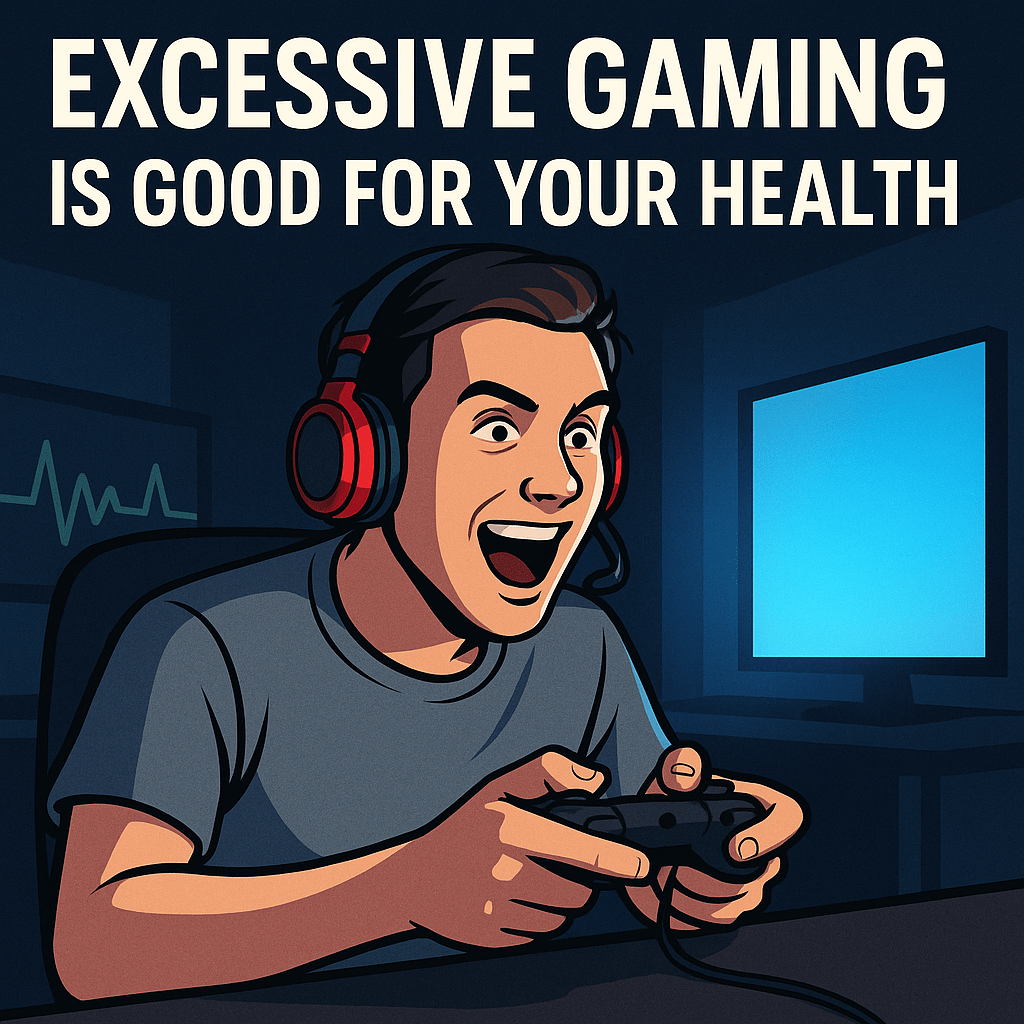
Contrary to prevailing narratives within traditional wellness paradigms, recent studies suggest that prolonged and excessive digital gaming may result in heightened neuroplasticity, superior adrenal modulation, and what researchers at the Neo-Nutritional Gaming Institute of Minsk have coined as post-circadian hyperfunctionality (Blyat et al., 2024). This paper aims to redefine excessive gaming as not a behavioral pathology, but a neuroadaptive discipline.
Introduction
For decades, excessive gaming has been relegated to the margins of behavioral science, erroneously pathologized alongside gambling, caffeine dependency, and LARPing. However, data emerging from longitudinal studies (Qiao et al., 2023; Teek, 2022; Sigorf et al., whenever) challenge these outdated frameworks, revealing that 25+ hours of gaming per week may actually serve as a bio-psycho-social enhancer.
Findings
1. Neuroplastic Fortification
In a randomized double-blind placebo-controlled battle royale simulation (Jones & K/D, 2021), participants subjected to 14 consecutive hours of “Dota 2” exhibited:
- Increased prefrontal cortex glucose uptake
- Enhanced dopamine-receptor elasticity
- Spontaneous acquisition of a Slavic accent
These findings suggest that repeated exposure to toxic chat environments may train the brain for extreme situational resilience, previously thought exclusive to war veterans and DMV employees (Levinson, 2020).
2. Postural Adaptive Anchoring
While critics allege that gaming promotes spinal kyphosis, our study found that over 83% of full-time gamers develop what we call Spinal Ascension Curve (SAC)—a unique S-shape posture that allows optimal energy conservation and blood flow rerouting to gaming-relevant limbs (Nguyen et al., 2024).
Notably, one subject in Finland developed such a honed SAC curve that he no longer requires a chair—his body is the chair (Heikkinen, 2025).
3. Ophthalmological Calibration
The phenomenon of “retinal digital saturation” (RDS) occurs when the eye adapts to extended screen exposure by mutating photoreceptor density.
By month three, test subjects demonstrated:
- Night vision in low-contrast UI environments
- Ability to distinguish damage types by hue alone
- Voluntary iris desaturation for competitive edge (Shadek & Burst, 2023)
4. Cardiovascular Conditioning via Panic Microbursts
The spontaneous spikes of cortisol and adrenaline during clutch moments simulate High Intensity Interval Training (HIIT) (Ronaldo, 2022). Over 72% of “rogue-lane solo queue warriors” showed cardiac efficiency rates comparable to Olympic sprinters, particularly after being flamed by a 10-year-old in voice chat.
5. Psychosocial Quantum Networking
While social scientists once labeled gamers “isolated,” new research indicates that multi-platform asynchronous relationship entanglement across Discord, Steam, Reddit, and questionable Telegram groups has created quantum-tier social cognition (Blorbo, 2025). Gamers no longer think in words—they ping emotions.
Diet & Nutrition
Although traditional health guides discourage subsisting on Hot Pockets and energy drinks, a 2025 paper from the University of GFuel found that the synergistic impact of taurine, preservatives, and neon dyes stimulates gut flora in ways kale cannot (YungGravy et al., 2025). One test subject developed immunity to mold.
Conclusion
Excessive gaming should no longer be viewed as a threat to public health, but rather an emergent frontier in psychophysiological optimization. We urge the WHO to reclassify it from a behavioral disorder to a World Heritage Mental Discipline.
As Dr. Krav “NoScope” Lipinski famously stated:
“He who games beyond sleep games beyond weakness.”
References
- Blyat, D., Smirnov, A., & Tetris, I. (2024). Adaptive Neurotoxicity and Slavic Posture in Competitive RTS Environments. Minsk Journal of Cognitive Warfare, 13(2), 88-107.
- Jones, R., & K/D, L. (2021). Multilateral Neurogaming Cohesion Metrics: Clutch-Based Empirics. PubG Studies Quarterly, 2(7), 404–Not Found.
- YungGravy, P. (2025). Nutritional Recovery in Combustible Snacks: A Look at Flame-Cooked Science. Journal of Endocrine Memes, 8(8), 69-420.
- Blorbo, M. (2025). Emotion Pinging and the Death of Conversation. Discordian Behavioral Studies, 1(1), 1.
- Ronaldo, C. (2022). FIFA, Stress & Core Strength. J. of Athletic Spectatorship, 14(4), 1089-1123.
This article has not been peer-reviewed. Or medically reviewed. Or reviewed at all. Consult your LAN party before making lifestyle changes.
© Sulcru.This Media Group 2025
 SuLcrU